Winterizing an RV in West Texas
West Texas winters are mild until, every few years, they are not. If the rig is in storage you winterize it: drain it, blow the lines, put antifreeze in the traps. If you are living in it — which is what most people here are doing — you are not winterizing at all. You are protecting a water system that has to keep working.
How cold it really gets
The National Weather Service office in Midland puts the average first freeze around mid-November and the average last freeze early in April. Most of those nights are the ordinary kind: below freezing for a few hours before dawn, back above it by mid-morning, nothing that troubles a rig with its furnace running.
February 2021 is the reason nobody here treats winter casually. It was the coldest February on record at Midland, averaging 40.4 degrees for the month. The temperature reached 2 degrees below zero on the 15th, and there were eight straight days when the high never climbed above freezing — a record. Eight days is long enough for cold to reach places a single frosty night never does. Plan for the ordinary winter; know that the other kind happens.
Water lines and the hose
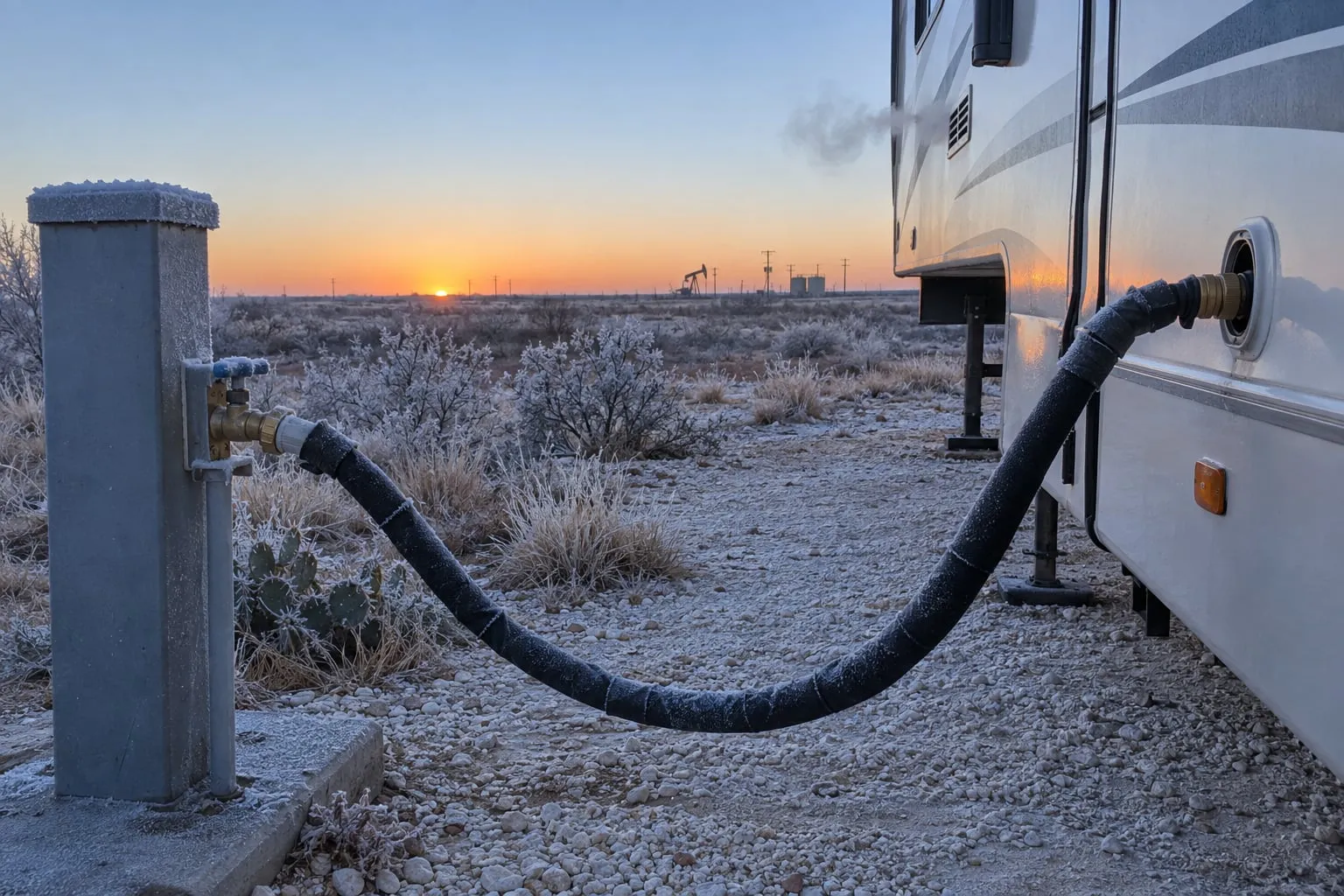
This is what actually fails, and it is almost never the plumbing inside the rig. It is the hose lying on the ground between the spigot and your inlet, and the spigot itself. Both are outside, both are thin-walled, and both freeze hours before anything indoors does.
A heated drinking-water hose solves it properly and is the standard answer for anyone living in a rig through a Permian Basin winter. Short of that, insulate the hose and the spigot, and on any night a hard freeze is forecast, disconnect the hose, drain it, and run off your fresh tank until morning. It is ten minutes of work against a split hose, a cracked fitting, or a water heater that has to be replaced.
Inside, leave a cabinet door or two open where plumbing runs against an outside wall, the same way you would in a house. A rig's basement bay is the other cold spot worth a look before the first freeze rather than after it.
Tanks and the sewer connection
Leave the grey and black valves closed and dump when the tanks are full, the way you would any other time of year. A sewer hose left open and half full is a hose with standing water in it, and standing water in a freeze is how the connection ends up solid.
Support the hose so it drains fully and sits off the ground where you can. Keep some tank antifreeze on hand for the holding tanks if a long freeze is coming — not the automotive kind, the RV kind.
Heat, and what it costs you here
Most rigs heat on propane, which is a real winter cost and yours to buy. Electric heat is the part that is different at this park: water, electric, and sewer are inside the monthly rate, so an electric heater running through a cold snap does not produce a larger bill at the end of the month. There is no meter on the space.
That is genuinely useful in a week like February 2021, when the honest choice at a metered park is between being cold and being surprised. It is not an invitation to be careless: run heaters as the manufacturer intends, keep them clear of bedding and curtains, and remember that a 30 amp space has a ceiling on what it will carry at once. Space heaters and an air conditioner and a water heater all at the same time is how a breaker finds its limit.
What the rate covers, and which amp tier you need →
A short checklist
- Heated hose fitted, or a routine for disconnecting and draining the one you have each evening.
- Spigot and any exposed line insulated before mid-November.
- Tank valves closed; sewer hose supported and draining, not standing full.
- Propane topped up before a front arrives, not during it.
- Cabinet doors open on outside walls when the hard freeze lands.
- Skirting or a windbreak at the underbelly if you are here for the whole winter.
Questions about the cold
Does it actually freeze in Midland?
Yes, most winters. The National Weather Service puts the first freeze of the season around mid-November and the last one in early April, so roughly five months of the year can produce one.
Will my water line freeze at an RV park?
The exposed run is what freezes — the hose between the spigot and your rig, and the spigot itself. The water inside a heated rig is usually fine; the twenty feet outside it is not.
Do I need a heated hose?
If you are living in the rig through the winter, it is the single piece of kit that earns its money. The alternative is disconnecting and draining the hose every night a freeze is forecast.
Does running a space heater raise my bill here?
No. Electric is inside the flat monthly rate at A1 RV Park, so a cold week does not produce a bigger bill. Use heaters the way the manufacturer intends and keep them clear of anything that burns.
Moving in before winter? Call and ask what is open. The rate does not change with the season, and neither does what it includes.